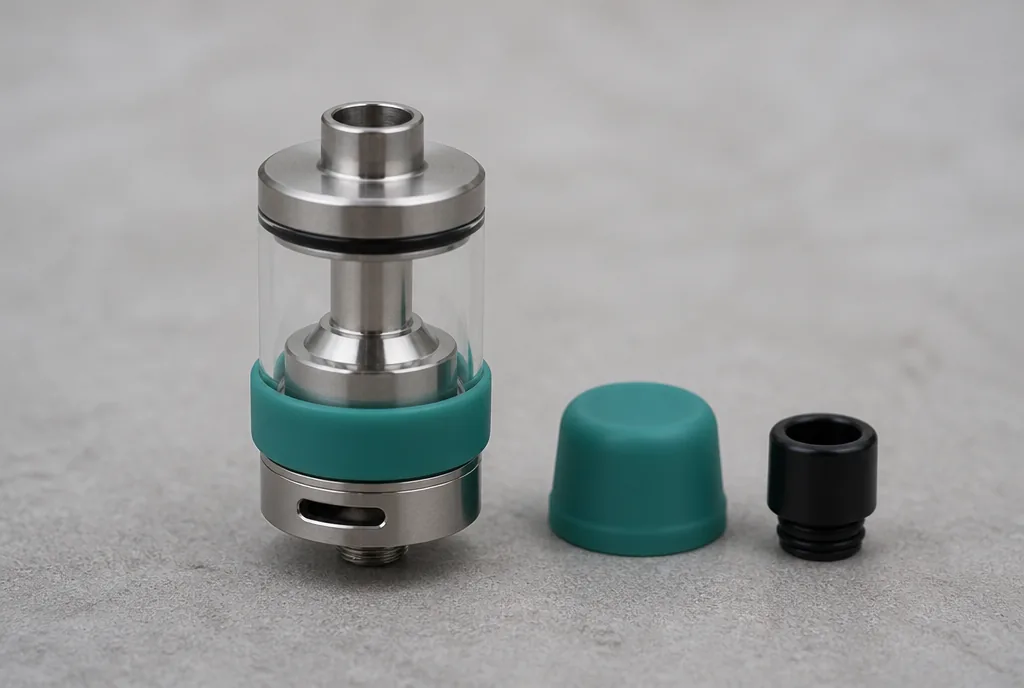
Vapeband and drip tip cap, protecting both ends of the tank
A glass tank has two weak spots, and they sit at opposite ends. At the bottom, the glass takes the knock when the kit slides off a table. At the top, the drip tip collects dust and fluff from the bottom of a pocket. A vapeband, the silicone ring you stretch over the glass, deals only with the first problem. The second has an accessory of its own, even smaller. The real question is what to measure before ordering either of them.
The vapeband, a silicone ring for the glass
A vapeband is a soft silicone ring stretched around the glass section of a tank or rebuildable atomiser. It stays put by tension alone. Its job is to absorb part of a knock and to limit scratches on the glass, and its colour also makes one tank easy to tell from another at a glance.
The word itself started life as a brand. The company behind the VapeBand®, a registered trade mark, says it invented the product and has been protecting glass tanks since 2014. Its original tank band comes in standard sizes of 22, 24, 26 and 28 mm. The name has since passed into general use, and British shops and marketplaces apply it to any protective band, written as one word or two.
As that 2 mm step shows, a band is chosen to the millimetre, and so is its partner at the mouthpiece end.
Two measurements before buying a vapeband
Pairing a band with a cap means knowing two dimensions, one for each end of the tank. Neither can be judged by eye, and callipers settle both in a few seconds.
The outside diameter of the glass
The first measurement is taken on the glass itself, at the exact height where the band will sit. Several straight bands are listed for glass of 22 to 28 mm, narrower designs go down to 18 mm, and bubble glass has bands of its own, listed for example at 24 to 28 mm.
A stated range is therefore not a universal size. The sensible order is to measure first, then read the listing for the model you have in mind, rather than trusting the word vapeband in a product title.
In the UK a refillable tank holds no more than 2 ml, and where the visible glass is only a short strip, the height of the band matters almost as much as its diameter.
The outside diameter of the drip tip
The second measurement concerns the mouthpiece. It is not the same thing as the connection size, since a 510 and an 810 tip differ first by the base that slots into the well, as our guide to 510 and 810 sizes explains. For a cap, only the part that stands proud of the tank counts, the part your lips touch.
Standard 510 tips sit within the range of the caps we looked at, which are designed mainly around that size. A wide 810 is more likely to fall outside it, and that is where buying a cap gets awkward.
The other end, the drip tip cap
The cap solves a different problem. It offers no protection in a fall. Its job is to keep dust, crumbs and pocket fluff away from the opening of the mouthpiece, the part that ends up in your mouth.
The silicone caps we looked at do not float around loose. They are tethered to a ring that goes around the tank, which stops them going missing and effectively turns them into a vapeband with a cap attached. One silicone dust cap on the market lists tanks of 18 to 25 mm and tips of 13 to 17 mm, built mainly for 510 tips and taking an 810 only if it is a narrow one. Other retailers sell drip tip protectors with an integrated band on the same principle.
These combined designs therefore call for both measurements at once. If either dimension falls outside the stated range, the whole thing fits badly, even if the other is right.
Fitting the pair without getting in the way of refills
On the glass, the height of the band is a trade-off. Fitted right at the bottom, it hides the base of the tank, exactly where you read how much e-liquid is left. Some designs have diamond cut-outs that show the level through the silicone, a useful option on a short glass section.
The safest method is to work with the tank off the device, held in the palm, and roll the band onto the glass. A band forced on from one side puts uneven pressure on the glass.
At the mouthpiece end, the cap’s ring should leave the top cap free to open on a top-fill tank. The nozzle of a 10 ml bottle, the largest size allowed for nicotine e-liquid in the UK, then reaches the fill port without taking everything apart.
What the pair does not protect
A band softens a knock, it does not cancel it. Glass can still break under a vapeband if the kit lands on the top cap or the base, two areas the silicone does not cover.
The device itself, screen and buttons included, stays exposed. An existing crack in the glass does not vanish under silicone, it is simply hidden, which delays replacing the glass without avoiding it. As for the cap, it keeps the mouthpiece clean but does nothing to make a tank leakproof.
Looking after the silicone of a vapeband and cap
Silicone holds on to everything it meets, dust, fluff and traces of e-liquid. A rinse in clean water followed by thorough drying is enough to bring it back.
The cap deserves more care, because its inner face touches a mouthpiece that goes in your mouth. Washing it at the same time as the drip tip is the simplest approach, following the method in our guide to cleaning a drip tip.
As a material, silicone has little in common with the Delrin or stainless steel used for mouthpieces, which are harder and stiffer and are covered in our comparison of drip tip materials. Its softness is exactly what lets it absorb a knock and stretch across a whole range of diameters.
Which vapeband for which kit
On a compact tank with straight glass, a narrow band is all you need. On a wider rebuildable atomiser, check that the diameter stays within the stated range, or the band ends up overstretched.
Bubble glass changes things, because a straight band creeps up towards the narrowest part. It needs a band designed for that shape.
Our view is clear. A band is worth having on any tank with straight glass, a cap on any kit carried without a case. Combined on a single ring, they only make sense if both measurements fall within the range of the model.
FAQ
Five questions come up again and again when ordering a band or a cap.
Does the cap have to come off before vaping?
Yes, since it blocks the opening of the drip tip. It comes off before each puff and goes back on afterwards. On tethered designs it stays attached to the tank in the meantime, so it never has to be put down on a table or slipped into a pocket.
Can the band get in the way of the airflow ring?
Only if it overhangs the glass. On a tank whose airflow control sits just below the glass, a vapeband fitted too low can touch it and make it stiff to turn. Sliding the band a few millimetres higher up the glass frees the control again.
What should I do if the band spins around the glass?
Either the glass sits at the bottom of the stated range, or the silicone has lost its stretch. In the first case, a band with a smaller range solves it. In the second, the band needs replacing.
Is a vapeband any use on a tank without glass?
Much less. A plastic tube, or a tank protected by a metal sleeve, is far less likely to break. The band then mostly serves as a colour marker and adds a little grip.
Can the tank be cleaned with the band still on?
It is better to take it off. E-liquid and rinse water collect under the silicone, against the glass, and dry out poorly there. Removing the band lets you clean both parts separately and dry them fully.
Vapeband and cap, one measurement at each end
The pairing comes down to two measurements and two roles. At the bottom, the band absorbs knocks on the glass, provided it falls within the right diameter range. At the top, the cap keeps the mouthpiece clear of dust, provided it covers a drip tip of the right width.
Measuring before you order is the only rule that counts. A well chosen vapeband and a cap matched to the width of the mouthpiece soon fade into the background, and these small, often overlooked parts are exactly what this magazine likes to examine up close.
Related reading
Editorial content for adult readers only. Vaping products contain nicotine, a highly addictive substance. Nicotine vaping products are not for sale to anyone under 18 in the UK. This article is not a buying recommendation.